A practical clinical guide for seating & mobility professionals
Selecting an alternative drive control for a power wheelchair is often approached as a device choice: a standard joystick, a mini joystick, a head array, switches, eye gaze... In practice, experienced clinicians know that control selection is rarely that simple.
A user may drive successfully in a quiet clinic, but still struggle in narrow hallways at home. A user may drive well, but cannot access tilt or seat elevation independently. A control method that works for ten minutes may collapse under fatigue after a full day. And what is safe today may not stay safe next year.
Drive control should therefore not be viewed as a single product selection. It is part of a broader system that translates human intention into reliable movement in real environments.This guide approaches control as architecture, not as a product list.
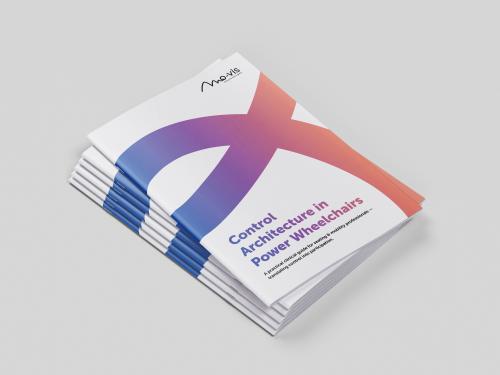
The guide is organized in five parts
- Foundations
Explains the conceptual framework behind control architecture and the Human Technology Interface. - The decision pathway
A step-by-step route from a standard joystick toward alternative options when needed. - Architecture after selection
Programming, access logic, and integration beyond driving. - Testing and evolution
Validating performance in real environments and managing control over time. - Clinical justification
How to justify an access method and thinking ahead about complications and safety.
Questions about this guide? Please contact us, we’re happy to hear from you.
Other downloadables:
Decision tree backbone
Decision tree for building a control solution that fits the person, the chair, and the environments.
Alternative proportional control
Decision tree that explores strategies that preserve proportional access.
Unsustainable proportional control
Decision tree for when proportional control is not sustainable
Justifying an access method
Checklist to build a strong clinical justification.
HAAT checklist
HAAT quick assessment checklist