From Motor Skills to Drive Control
Matching Force, Throw & Placement in Special Power Wheelchair Controls
Selecting a special drive control is not about choosing a joystick.
It is about matching human motor capacity to interface mechanics.
When standard joysticks no longer meet a user's needs, clinicians must analyze three core variables:
- Operating force
- Throw (displacement)
- Control site placement
If any one of these is mismatched, access becomes unreliable, fatiguing of unsafe.
This article outlines a structured approach to translating motor skill assessment into precise drive control selection - and includes a clinical decision tree you can apply immediately.
Step 1: Start With Motor Skill — Not the Product
Motor control is multidimensional. Before selecting a device, assess:
-
Strength (minimum and sustained)
-
Range of motion (ROM)
-
Fine motor resolution
-
Endurance across the day
-
Tone variability or spasticity
-
Reliability under repetition
Only after defining the motor profile should the drive control be chosen.

Force Matching: When 8g vs 650g Changes Everything
Operating force determines how much physical effort is required to activate the control.
Ultra-Low Force Applications
For users with:
-
Muscular dystrophy
-
Early ALS
-
Severe weakness
-
Limited endurance
An ultra-sensitive option such as a Micro Joystick requiring approximately 8 grams of force and only 3.3 mm displacement can dramatically reduce fatigue and improve sustainability.
Clinical advantages:
-
Minimal energy expenditure
-
Reduced joint strain
-
Supports very weak but precise movements
-
Enables prolonged use across the day
However, ultra-low force is not universally appropriate.
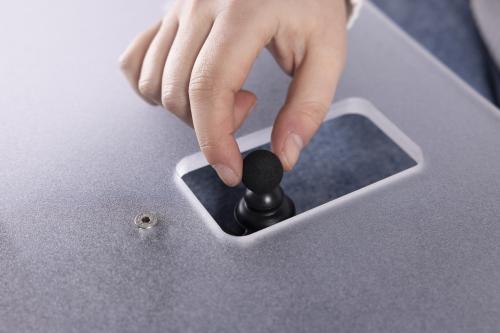
High-Force / Spasticity Management
For users with:
-
Spasticity
-
Increased tone
-
Involuntary movement
-
Large amplitude gross movements
A Heavy Duty Joystick requiring approximately 650 grams of force and offering 40 mm of displacement may provide improved stability and control.
Clinical advantages:
-
Reduces accidental activation
-
Dampens tremor impact
-
Supports users with strong but poorly modulated force output
-
Accommodates larger movement patterns
High tone often requires resistance.
Low strength requires sensitivity.
Force must match physiology — not preference.

Throw Distance: The Overlooked Variable
Throw (displacement) defines how far the control must move before reaching maximum output.
Short throw (e.g., 3.3 mm):
-
Ideal for limited ROM
-
Reduces fatigue
-
Supports fine motor precision
-
Faster response
Long throw (e.g., 40 mm):
-
Useful for users with large gross movement patterns
-
Can increase control stability
-
May improve modulation for high-tone users
A common mistake is selecting based on force alone.
Force without considering throw can still result in fatigue or instability.
Placement: Access Fails Without Positioning
Even perfectly matched force and throw fail if placement is inconsistent.
Consider:
-
Is the control aligned with natural movement arc?
-
Is midline orientation stable?
-
Can the user return to neutral consistently?
-
Is swing-away required for transfers?
-
Will posture change over time?
Mounting determines reliability.
Inconsistent positioning increases:
-
Cognitive load
-
Fatigue
-
Steering errors
-
Safety risks
Access is biomechanical before it is electronic.
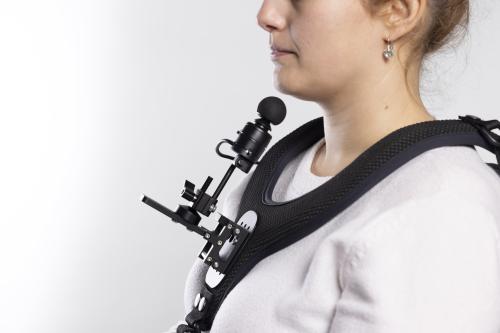
The Key Principle
The best joystick is not the most sensitive.
The best joystick is not the most robust.
The best joystick is the one that precisely matches:
-
Motor strength
-
Range of motion
-
Tone profile
-
Endurance pattern
-
Placement geometry
When force, throw, and positioning are aligned with physiology, access becomes:
-
Sustainable
-
Reliable
-
Safer
-
Easier to justify clinically
-
Adaptable over time
Special drive control selection is not about hardware.
It is about translating motor skill into functional independence.